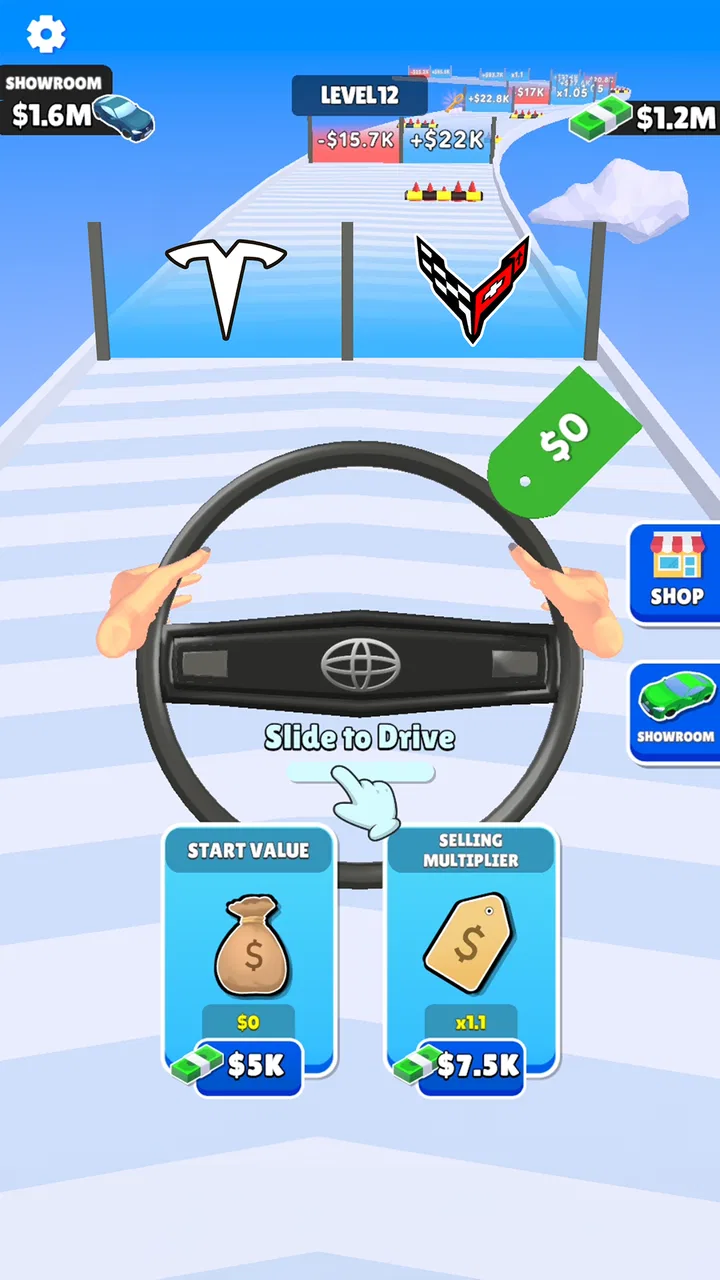
Steering Wheel Evolution
- 4.7
- Rating
- 50.00M
- Installs
- Free
- Price

 Analysis by App-foxy
I spent time with Steering Wheel Evolution as a quick, casual action game, and my first impression was easy to understand: it is built around driving forward, collecting progress, and watching that progress turn into a more impressive car collection. The basic idea is approachable enough for a short break, but the real question is whether the repeated driving loop gives you enough reason to keep returning.
That answer depends on what you want from a mobile driving game. If you are looking for a realistic simulator with detailed handling, this is not the direction I would point you toward. If you want something lighter, faster to learn, and focused on visible evolution rather than technical driving, it makes more sense. The game comes from Homa, is free to download, and is rated for Everyone, so it is clearly aimed at a broad audience rather than a specialist racing crowd.
How the driving-and-evolution loop feels
The central appeal is the connection between driving and upgrading your collection. You are not simply completing a race and moving on; the forward movement is tied to the idea of evolving toward better steering wheels and supercars. That gives each short session a simple purpose. Even when the action itself feels familiar, there is a clear visual reward waiting at the end of the run.
You May Also Like

 Blood Strike: 2.5 Anniversary
Blood Strike’s Loadouts Turn Every Drop Into a Tactical Gamble
A close look at Blood Strike’s custom loadouts: how fast access to signature weapons reshapes its battle royale rhythm, rewards preparation, and narrows the gap between fights.

 Pandora - Music & Podcasts
Pandora’s Music Is Easy to Start, but Harder to Recover
Pandora’s strength is its low-effort path from a seed to a station. Its weak spot is how much confidence it asks you to place in connection, setup, and quiet recovery.

 8 Ball Pool
 Is Built on Rivalries, Rematches, and Routine
A close look at the rivalries, rematches, shared routines, and unanswered safety questions that turn a quick pool match into a persistent mobile community.

 Samsung Music
’s Quiet Strength Is Playing What You Already Own
Its reach comes less from spectacle than from dependable access to a personal library. That simplicity is both the app’s strongest retention engine and its ceiling.

 AccuWeather: Weather Radar
AccuWeather Review: A Quick, Clear Forecast for Everyday Decisions
For everyday plans, the best forecast is the one you can understand quickly. AccuWeather makes rain timing, radar, and local conditions easy to act on, with a few trade-offs.

 Hill Climb Racing
Why Hill Climb Racing Still Turns Crashes Into One More Run
A tiny car, a bumpy hill and one more upgrade: Hill Climb Racing keeps resurfacing because its simple chaos makes every near-miss feel personal.
More From Our News Desk



I found this structure particularly suitable for people who prefer games that explain themselves through play. You do not need to study a long tutorial or learn a complicated control scheme before understanding the goal. The store description presents it as a game about driving to evolve, and that focus is reflected in the way the experience is framed: move, improve, and build toward more desirable vehicles.
The important distinction is that this is an action game with a driving theme, not a full racing simulation. I would not install it expecting realistic braking points, deep tuning, licensed circuits, or the kind of precision demanded by a traditional console racer. Its satisfaction comes from the rhythm of short actions and visible progression, not from reproducing the exact feel of a real car.
That makes it easy to pick up while waiting for transport, taking a short break, or looking for something that does not require a long uninterrupted session. A realistic everyday use case is a few minutes between tasks: I can open the game, make progress toward the next vehicle goal, and leave without needing to remember a complicated campaign state. Players who enjoy longer races and strategic preparation may find that simplicity limiting instead of convenient.
What the free entry point actually means
The game is free, which matters when deciding whether it deserves a place on your phone. You can try the core experience without paying an upfront purchase price, so the initial decision is low risk. That is useful for families, younger players, and anyone who prefers testing a casual game before spending money on it.
There are in-app purchases ranging from $0.99 to $39.99 per item. I would treat that range as a reason to make a deliberate choice rather than an automatic problem. Free access gives you a way to judge the driving loop first, while the purchase options create a separate spending decision. The value of any paid item depends on how much you play and whether it changes your experience in a meaningful way for you.
In practical terms, I would begin with a no-spend session and ask three questions: am I enjoying the moment-to-moment driving, do I care about the next evolution, and does the collection goal keep me interested after the novelty fades? If the answer to those questions is no, paying will not fix the underlying mismatch. If the answer is yes, a purchase may feel more reasonable, but only as an optional convenience or enhancement rather than something required to discover whether the game suits you.
The strongest value is available before you spend anything. That is the fairest way to look at the pricing model. The game gives you an opportunity to sample its main idea, while purchases should be judged against your own play time rather than against the excitement of seeing a more advanced car.
Where the value comes from
The main value is immediacy. Steering Wheel Evolution does not ask me to commit to a long competitive season or master a complex vehicle setup. Its appeal is that the goal is visible and easy to understand. For a casual player, that can be more valuable than a technically richer game that takes longer to learn.
The collection angle also gives the game a natural reason to continue. Unlocking or reaching a more desirable vehicle is a clearer motivation than simply repeating identical runs with no visible change. The promise of cool steering wheels and a supercar collection gives the progression a recognizable identity, even for someone who is not deeply interested in car games.
Another useful strength is the broad age positioning. The Everyone rating suggests that the game is designed to be accessible to a general audience. I would still recommend that parents handle spending settings carefully on a device shared with children, because the game includes optional purchases. The age rating makes the content approachable, but it does not remove the need for sensible purchase controls.
The game’s popularity also gives a prospective player some context. It has passed 50 million installs, carries a 4.7 average from around 261 thousand ratings, and has around 2 thousand written reviews. Those figures do not guarantee that every player will enjoy the same loop, but they do indicate that the concept has reached a large audience and earned a strong overall response.
I would not use those numbers as a substitute for personal testing. Casual action games can receive positive reactions because they are immediately understandable, while still becoming repetitive for players who want depth. For me, the figures support trying it, not committing to purchases before seeing how long the progression remains engaging.
The less obvious tradeoffs during play
The first tradeoff is simplicity versus depth. The uncomplicated structure helps the game work as a quick distraction, but it also means that players searching for advanced driving technique may run out of meaningful decisions. If your enjoyment comes from comparing lap times, adjusting suspension, or learning demanding tracks, a dedicated racing title will probably offer more lasting substance.
The second tradeoff is progression versus repetition. The evolution theme gives repeated actions a purpose, yet the same purpose can lose impact if the driving itself does not keep changing enough. My advice is to pay attention to whether you are enjoying the run or merely tolerating it to reach the next visual reward. That distinction is a useful test before considering an in-app purchase.
The third tradeoff concerns collection appeal. A growing car collection can be satisfying for players who like completion goals, but it may have less value for someone who only wants a single polished driving experience. If you are not interested in comparing vehicles or moving toward the next upgrade, the collection framework may feel like decoration around a simple action loop.
A practical tip is to play in short, separate sessions rather than forcing a long sitting. This type of design often works best when treated as a compact activity. If you play until the actions feel repetitive, you may judge the game more harshly than if you use it for the brief bursts it appears designed to support. That does not solve repetition, but it can make the intended rhythm clearer.
Another tip is to decide your spending boundary before handing the phone to a child or starting a longer session. Because the game is free to access but includes individual purchases from $0.99 to $39.99, a simple personal rule is useful: try the free experience first, then spend only if the added value is clear to you. This keeps the decision connected to enjoyment instead of impulse.
How it compares with other mobile driving choices
Compared with a conventional racing game, this title is more approachable and less demanding. A traditional racer usually earns its place through track knowledge, vehicle handling, competition, or customization depth. Steering Wheel Evolution instead leans on a compact action loop and the satisfaction of evolving toward better-looking cars. That makes it easier to recommend for casual play, but harder to recommend as a complete racing hobby.
Compared with a driving simulator, the difference is even sharper. Simulators are for players who want control, realism, and a sense that every input matters. This game is better suited to someone who wants the idea of driving without turning the phone into a technical cockpit. Choosing between them is not about which is universally better; it is about whether you want accessible progression or authentic driving complexity.
It also differs from a purely endless arcade game because the collection goal gives your actions a direction. An endless title may focus on surviving as long as possible or beating a personal record. Here, the promise of evolution and supercars provides a more concrete reason to continue. The downside is that once the collection motivation weakens, the simpler action may not be enough on its own.
Who is most likely to enjoy it
I would recommend it to players who enjoy casual action games, visible progression, and car-themed collecting. It is a good candidate for a shared family device because the content rating is Everyone and the basic premise is easy to explain. I would also suggest it to someone who wants a free game that can be tested in small sessions without learning a large rule set first.
It is especially suitable for players who like the emotional reward of moving from an ordinary starting point toward something more impressive. The steering-wheel evolution idea gives the game a clear personality, and the supercar collection provides a goal that is easy to recognize even if you are not a dedicated automotive fan.
I would skip it if you need realistic physics, serious competition, detailed customization, or a deep career mode. I would also be cautious if repetitive action quickly frustrates you. The free price makes trying it sensible, but it does not change the central design tradeoff: the game favors accessibility and quick progress over elaborate systems.
Players who dislike optional purchases should also decide whether the free experience feels complete enough for them. Since the game is free to start and offers paid items, the right approach is to treat spending as entirely separate from the initial download. If you already know that seeing purchase prompts makes a game unpleasant, a premium alternative with one upfront price may be a better fit, even if it offers less immediate accessibility.
Device details and what to expect from the current release
The game was released on May 10, 2022, and the current version is 2.9.0. It requires Android 7.1 or later, so owners of relatively old Android phones may still be able to try it, provided their device meets that minimum. I would check compatibility before planning to install it on an older handset, especially if the phone is shared with a child or used mainly for basic tasks.
Those details also help set expectations. This is not a brand-new experiment waiting to establish its identity; it has been available for several years and has built a substantial audience. At the same time, a current version number does not tell me how much the experience has changed over time, so I would judge it by the present gameplay rather than assuming that its history guarantees ongoing novelty.
The developer, Homa, is associated here with a simple, broadly accessible action format. That fits the game’s quick-to-understand presentation and its emphasis on immediate progression. I would approach it as a casual mobile release first, not as a substitute for a dedicated racing platform.
My recommendation after weighing the value
For me, Steering Wheel Evolution is worth trying because its free entry point matches its biggest strength: it is easy to understand quickly. The driving-to-evolution concept gives short sessions a clear purpose, and the car collection theme adds more personality than a completely directionless arcade loop. The strong average rating and large install base make it a reasonable candidate for anyone browsing for a popular casual action game.
My recommendation becomes more qualified once money enters the picture. I would not buy anything immediately. I would first see whether the basic driving remains enjoyable after the first burst of curiosity and whether the next vehicle genuinely motivates me. The available purchase range is wide enough that careful spending matters, particularly on a shared device.
In the end, I see it as a good free-time game rather than a serious racing destination. It delivers value through accessibility, quick goals, and collection-driven motivation. It loses value for players who need technical depth or dislike repetition. If you want a lightweight action game with a car-evolution hook, I think it is worth downloading and testing without spending. If you want realistic driving or a rich competitive career, I would choose a different kind of game instead.
My buy-or-skip verdict: try the free version if you enjoy casual car collection and short action sessions; skip it if your idea of a driving game depends on realism, precision, or extensive customization. The best reason to keep it is that the simple loop fits naturally into spare moments, not that paid items are necessary to make the concept work.
FAQs for Steering Wheel Evolution
01What is Steering Wheel Evolution about?
Steering Wheel Evolution is an engaging simulation game where players get to experience the thrill of driving various vehicles. Players can upgrade and customize their steering wheels, navigate through challenging courses, and compete to achieve high scores. The game combines elements of strategy and skill, providing an immersive experience for racing enthusiasts.
02Is Steering Wheel Evolution free to play?
Yes, Steering Wheel Evolution is free to download and play. However, it offers in-app purchases that allow players to enhance their gaming experience. These purchases can include new steering wheel designs, vehicle upgrades, and additional levels or features. While not necessary to enjoy the game, they can provide added benefits.
03What devices are compatible with Steering Wheel Evolution?
Steering Wheel Evolution is available on both Android and iOS platforms. It is compatible with most modern smartphones and tablets. Users should ensure their device meets the minimum operating system requirements, which are typically Android 5.0 and above or iOS 10.0 and above, for optimal performance.
04Does Steering Wheel Evolution require an internet connection?
Steering Wheel Evolution can be played offline, making it a great option for gaming on the go. However, certain features such as in-app purchases, leaderboards, and updates require an internet connection. Players can enjoy the core gameplay without needing to be connected to Wi-Fi or mobile data.
05Are there any parental controls available in Steering Wheel Evolution?
Steering Wheel Evolution includes parental controls to help manage in-app purchases and screen time for younger players. Parents can use device settings to restrict purchases and monitor gameplay. The game is designed to be family-friendly, with content suitable for a wide age range, providing both fun and educational elements.
Pros
- Intuitive controls enhance gameplay.
- Diverse range of vehicles to unlock.
- Smooth graphics and animations.
- Engaging sound effects and music.
- Frequent updates with new content.
Cons
- Ads can be quite intrusive.
- In-app purchases can be costly.
- Occasional bugs disrupt play.
- Limited offline functionality.
- Battery drains quickly during use.

Steering Wheel Evolution
Gallery